
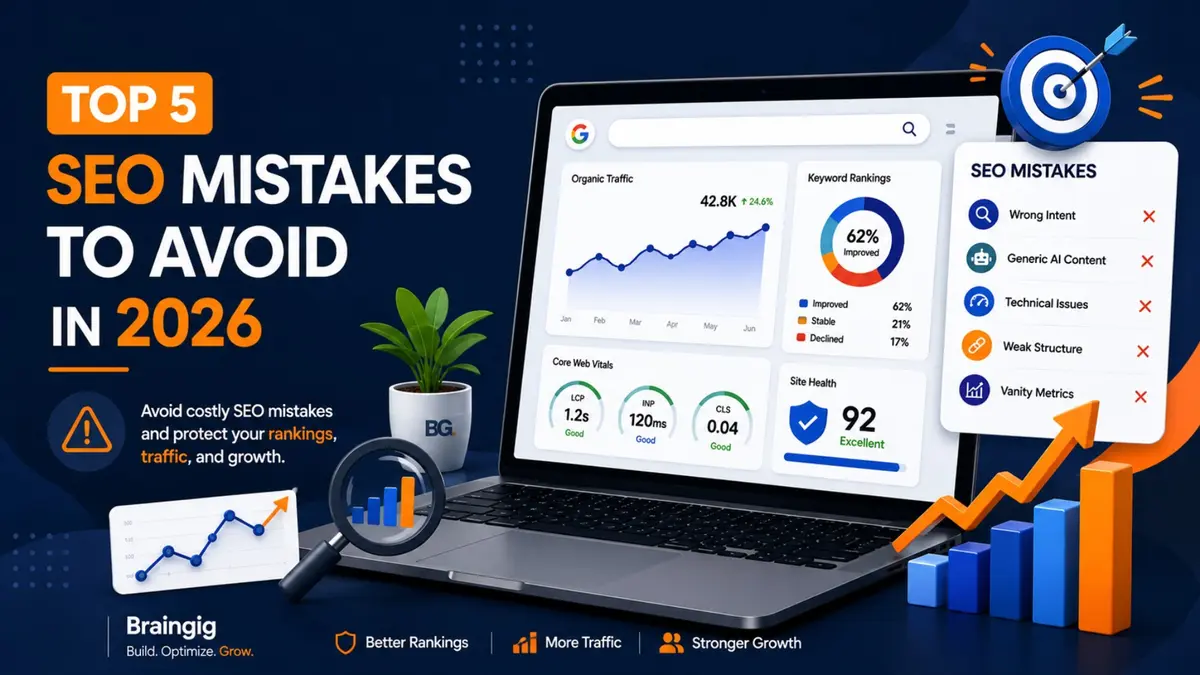
Over the last few years, I’ve audited a lot of websites that were “doing SEO” but still kept losing rankings, clicks, and leads. And in most cases, the problem was not one huge technical disaster. It was a pattern of SEO mistakes and a few very common SEO mistakes to avoid that kept piling up quietly until performance dropped.
In this guide, I’ll walk you through the top 5 SEO mistakes to avoid in 2026, whether you’re a small business owner, a marketer managing a company’s site, or a blogger trying to grow. These are the most common SEO mistakes I see across all of them, and fixing even one or two can make a real difference. I’ll keep it simple, practical, and backed by examples and data so you can actually use it.
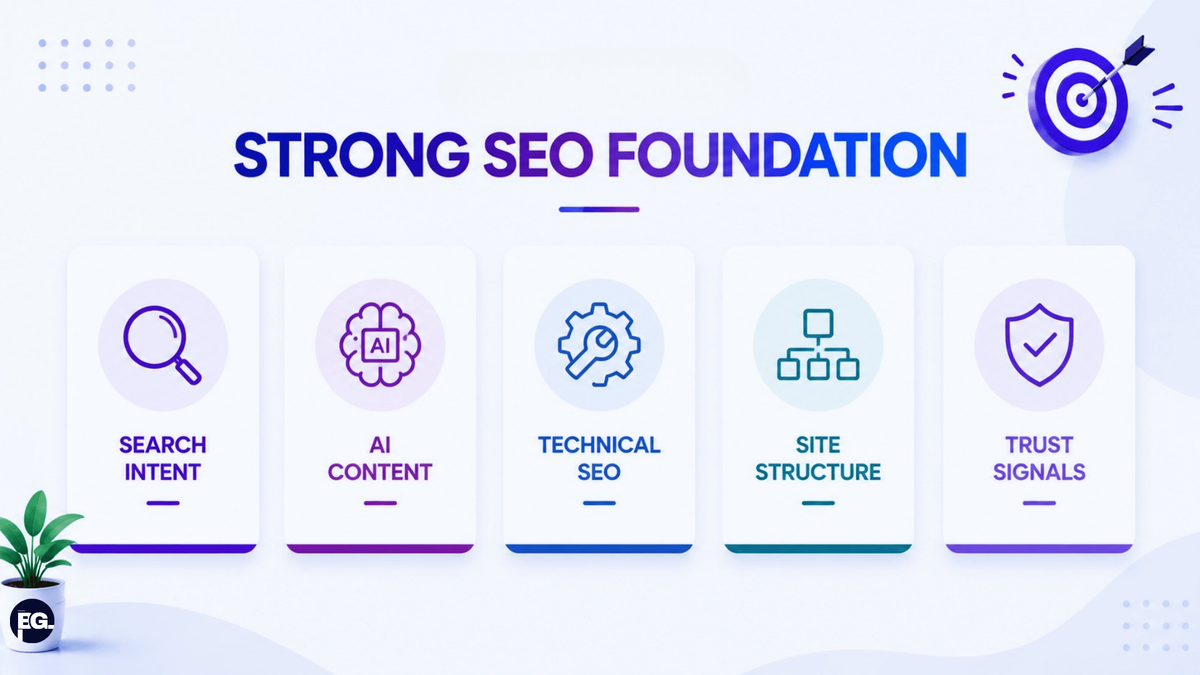
If you want the quick version, here are the top SEO mistakes to avoid this year:
BrainGig note: The best way to avoid SEO mistakes in 2026 is to stop treating SEO like a checklist of tricks and start treating it like a full system built around intent, trust, structure, and real business outcomes.
| Mistake | What it looks like in real life | Simple fix to start with |
|---|---|---|
| Keywords over intent | Pages mention the keyword but don’t solve the actual query | Map the intent first, then choose the right page type |
| Generic AI content | Thin articles with no examples, no originality, no experience | Use AI for drafts only; add real insight, proof, and human editing |
| Weak technical SEO | Slow pages, layout shifts, crawl issues, indexing gaps | Audit Core Web Vitals, mobile UX, sitemaps, and indexability |
| Poor structure and linking | Orphan pages, weak clusters, random links | Build content hubs and use clear internal linking |
| Vanity metrics over outcomes | Good rankings reports but weak leads and sales | Track conversions, improve trust signals, and measure business impact |
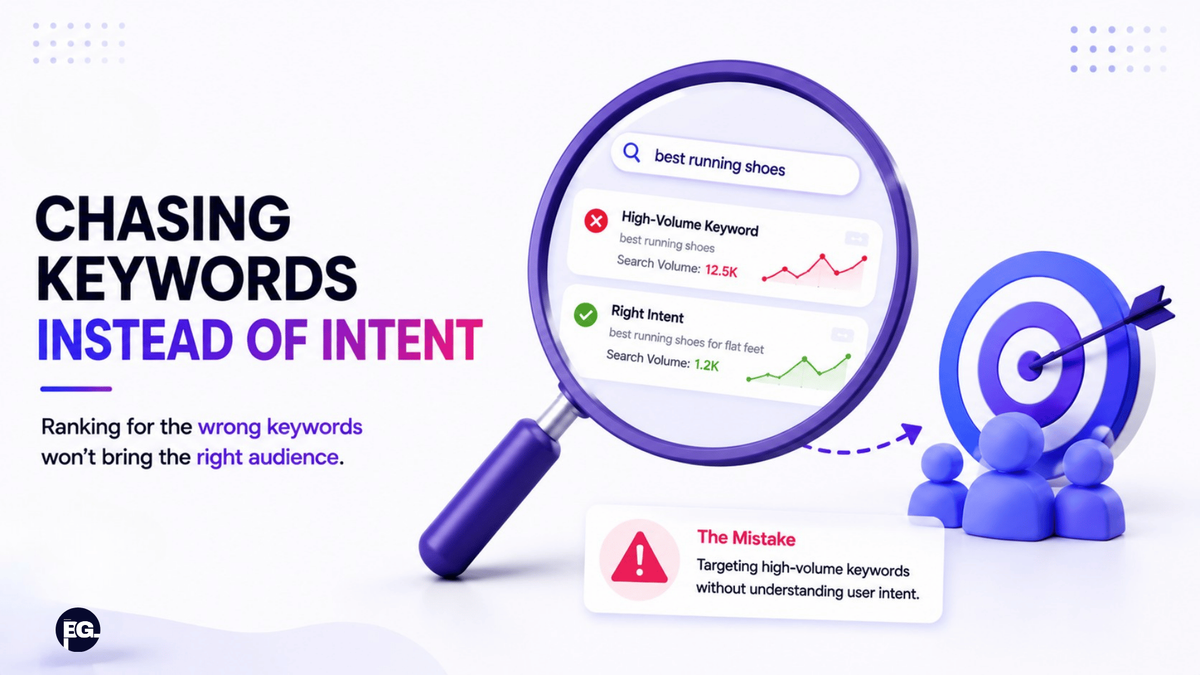
When I audit pages that have slipped in rankings, one of the first things I check is whether the content actually matches the search intent. A lot of businesses still optimize for a phrase, but they do not stop to ask what the person behind that search actually wants.
That’s one of the most common SEO mistakes to avoid right now. Yoast, Semrush, and other SEO guides keep pointing to similar problems: wrong keyword targeting, weak keyword strategy, and pages that aim for search volume without matching the real need behind the search.
Here’s what this usually looks like:
If you fix this one issue alone, you avoid a surprising number of SEO mistakes because the whole content strategy becomes clearer. It also helps prevent keyword cannibalization where multiple pages on your site unintentionally compete for the same query, splitting authority and confusing Google about which page to rank.
I use AI tools myself, so I’m not anti-AI. But one of the biggest SEO mistakes to avoid in 2026 is publishing AI-assisted content that sounds polished on the surface while saying almost nothing original underneath.
Since March 2024, Google’s Helpful Content system has been fully integrated into the core ranking algorithm, not a separate update but a continuous real-time signal. The result was a 45% reduction in low-quality, unoriginal content in search results. Multiple SEO analyses keep repeating the same idea: content created mainly to rank, rather than to help, is far more likely to lose visibility over time. This is also why “content at scale” often backfires when every article sounds like a slightly reworded version of the one before it. To be clear, Google does not penalize AI content itself, it penalizes low-quality content, whether written by a human or generated by AI.
You can usually spot this SEO mistake when:
This is one of the most common SEO mistakes to avoid because it feels productive when you’re publishing fast, but the long-term value is often weak.
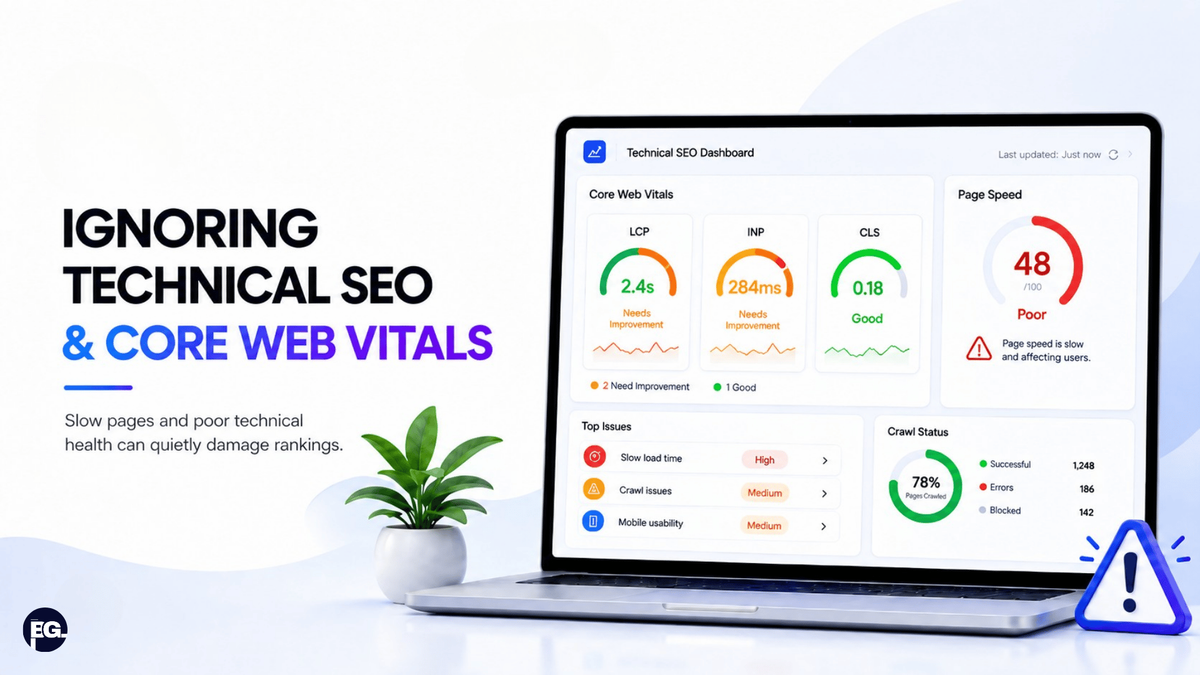
This is one of the oldest SEO issues, and it is still one of the most common SEO mistakes to avoid. I’ve seen businesses invest heavily in content while the site itself stays slow, poorly indexed, or broken on mobile.
Google’s documentation and technical SEO resources continue to stress the importance of Core Web Vitals and clean technical foundations. Largest Contentful Paint (LCP), Interaction to Next Paint (INP), and Cumulative Layout Shift (CLS) all matter because they reflect loading speed, responsiveness, and layout stability. Technical SEO guides also recommend aiming for LCP under 2.5 seconds, INP under 200 milliseconds, and CLS under 0.1 for a good user experience. These are measured against the 75th percentile of real user data from Chrome, so it is not enough for your page to be fast sometimes, it needs to be fast for most visitors. You can check all three in Google Search Console or run a quick test using PageSpeed Insights.
Some of the most common technical SEO mistakes include:
These aren’t flashy fixes, but they solve some of the most damaging SEO mistakes you can make. One important nuance: good Core Web Vitals scores alone don’t guarantee top rankings. Google itself states that CWV helps most when other ranking signals (content quality, relevance, authority) are already close between competing pages. Think of technical SEO as the floor, not the ceiling.
A lot of sites do not have a content problem. They have a structure problem. Their best pages are buried, their blog posts do not support each other, and nothing clearly tells Google which pages are the most important.
This is one of the most common SEO mistakes to avoid because it is easy to miss. Yoast, Semrush, and multiple technical SEO sources continue to mention internal linking and site structure as basic but critical parts of SEO performance. In 2026, it matters even more because AI systems often pull answers from clearly structured sections, FAQs, and passage-level content. A 2024 Ahrefs study also found that 66.2% of web pages have only one internal link pointing to them, which means most websites are severely underusing one of their easiest ranking levers.
You can spot this issue when:
This helps avoid both classic SEO mistakes and newer AI-search visibility problems.
Another one of the most common SEO mistakes to avoid is thinking that better SEO always means more business just because traffic went up. I’ve seen too many reports celebrating impressions and rankings while leads, calls, and revenue barely move.
A lot of SEO guides now point out that focusing only on surface metrics can create a false sense of success. Traffic matters, but so do conversions, user trust, relevant backlinks, authorship, and clear signs of expertise. If you only track rankings and never ask which pages lead to enquiries or sales, you can make SEO mistakes for months without realizing it.
Here’s what this looks like in practice:
This is one of the SEO mistakes that hurts quietly because dashboards can still look impressive while business performance stays flat.
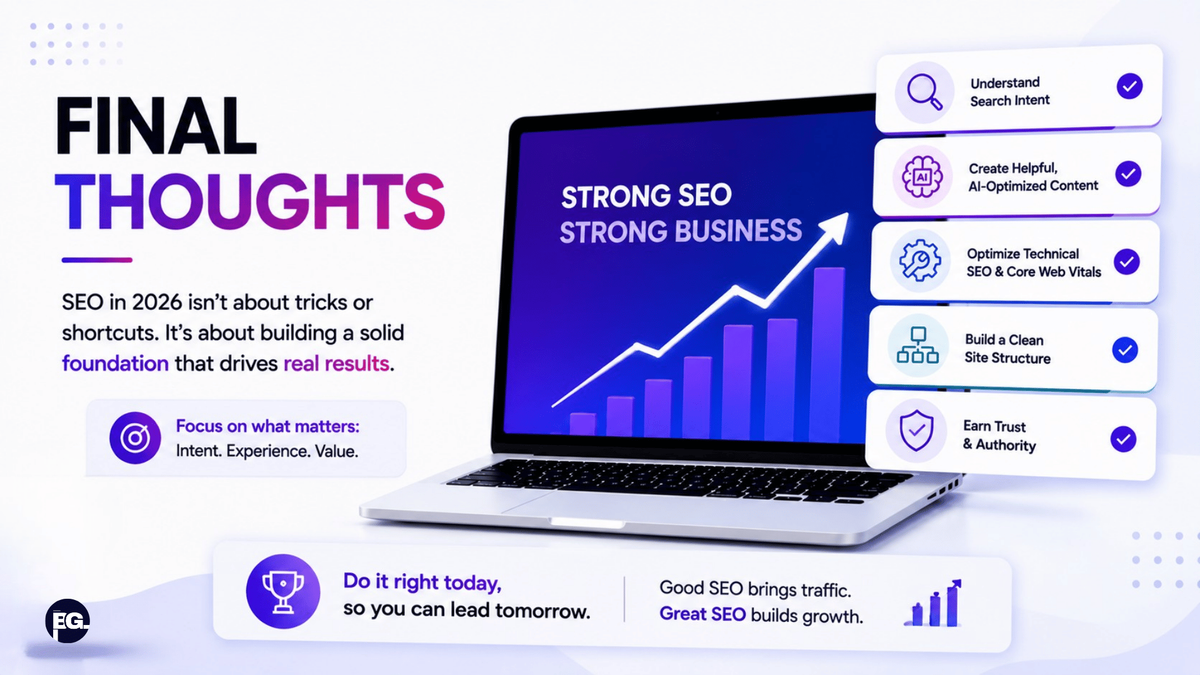
From what I’ve seen in audits, most ranking drops come from a cluster of issues, not one dramatic failure. That’s why the smartest approach is not just to find one bug or rewrite one article, but to look at the full system behind your content, site structure, technical SEO, and trust signals.
If you focus on fixing the most common SEO mistakes to avoid like intent mismatch, generic content, weak technical health, poor structure, and vanity-first reporting, you give your site a much better chance to stay stable through updates and perform better in both traditional search and AI-driven results.
BrainGig helps businesses fix SEO mistakes, strengthen content strategy, improve technical performance, and build a smarter search presence that turns traffic into leads. Contact us now to get started.
Q: What are the most common SEO mistakes to avoid in 2026?
A: Some of the most common SEO mistakes to avoid are ignoring search intent, publishing generic AI content, neglecting technical SEO, using weak internal linking, and tracking vanity metrics instead of business results.
Q: Why is search intent so important now?A: Because Google is much better at ranking pages that solve the real need behind a query, not just pages that repeat the keyword phrase.
Q: Is AI-written content always bad for SEO?
A: No. Google does not penalize AI-generated content by definition, it penalizes low-quality content regardless of how it was created. AI-assisted content can rank well when it is edited, improved, and supported with real insight, examples, and first-hand experience. The problem is when AI is used to publish content at volume without any human value added, which is what triggers Google’s Helpful Content signals.
Q: Why do technical SEO mistakes still matter so much?
A: Because even strong content can struggle if the site is slow, unstable, poorly indexed, or difficult for Google to crawl and understand.
Q: What makes vanity metrics dangerous in SEO?
A: They can make SEO look successful on paper while hiding the fact that the traffic is not generating real leads, trust, or sales.
One of the biggest SEO mistakes to avoid for small businesses is targeting broad keywords with no realistic chance of ranking instead of focusing on specific, relevant, intent-based terms.
Yes. Older SEO often focused too much on keyword placement and backlinks alone, while 2026 SEO puts much more weight on helpful content, structure, performance, and AI-friendly clarity.
A light audit every quarter is a practical rhythm for catching technical issues and content gaps early. Run a deeper review after major Google core updates (which typically happen 2- 4 times a year), as these can shift what’s working. At minimum, check Google Search Console monthly for crawl errors, indexing issues, and declining pages.
Sometimes, yes. Especially when the issue is technical or structural but in most cases the real gains come from steady improvements over time rather than one quick fix.
Not always. You can fix many SEO mistakes internally if you have the time and skills, but agencies can help when the issues involve deeper audits, technical cleanup, content strategy, and ongoing execution.