
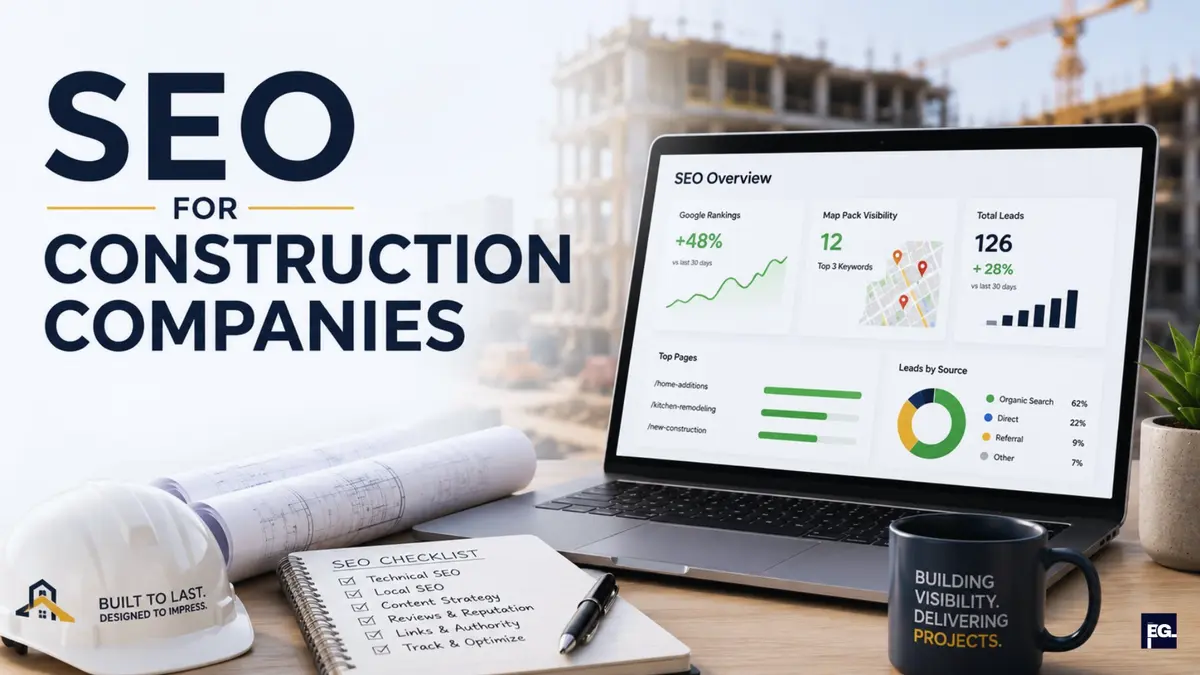
In the last few years, I’ve worked with construction companies, home improvement brands, and local contractors who all had the same complaint: “We do great work, but our website barely shows up on Google and the phone is quiet.”
In this guide, I’ll walk you through how I think about SEO for construction companies in 2026: not just “rank higher,” but build a trusted online presence that shows up in Google, Google Maps, AI answers, and review sites and actually turns those views into project inquiries. I’ll keep it practical, use real numbers from construction and local SEO studies, and focus on things a small or mid-sized construction business can realistically implement. If you are a general contractor, a specialty trade contractor, or a remodeling company trying to win more local jobs, this guide is built specifically for you.
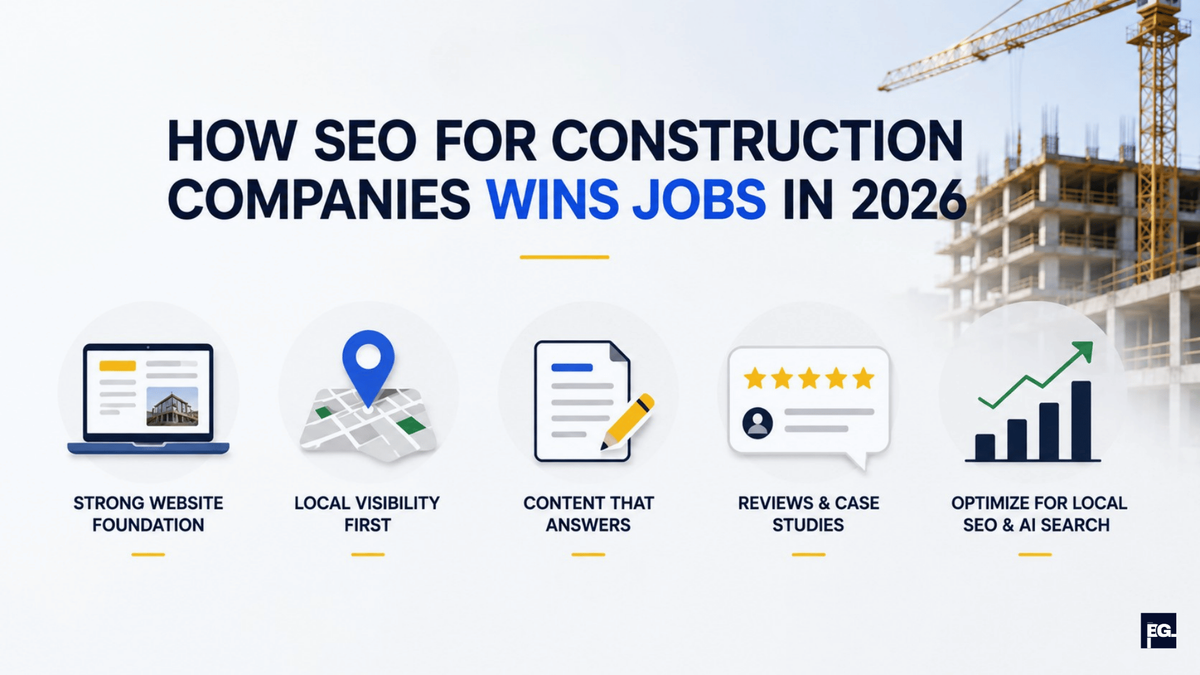
If you want the short version, here’s how I approach SEO for construction in 2026:
If you keep reading, I’ll break all of this into a step‑by‑step process you can follow even if you’re not a marketer.
BrainGig helps businesses grow with premium SEO, web design, and performance-driven digital marketing. Book a free consultation today.
| Step | What it means in real life | Simple action to take |
|---|---|---|
| 1. Clarify your ideal projects | Focus SEO on the types of jobs and areas you actually want | Write down top 3 services and 3 priority service areas |
| 2. Fix your foundation (site + GBP) | Website, Google Business Profile, and basic listings fully accurate and up to date | Standardize Name Address Phone (NAP), update GBP, and clean up key directories |
| 3. Build focused service + location pages | Each main service and region gets its own optimized page | Create “service in city” pages with photos, FAQs, and clear CTAs |
| 4. Use content to answer buyer questions | Blogs and guides that answer real pre‑sale questions | Publish 1–2 guides per month on common concerns (cost, timelines, permits, risks) |
| 5. Systematize reviews and case studies | Turn every good project into public proof | Ask for reviews, document before‑after photos, and turn them into case study pages and social proof blocks |
| 6. Build authority with citations and links | Get mentioned on trusted construction and local sites | Claim listings, join local directories, and earn links from partners, suppliers, and associations |
| 7. Track leads, not just rankings | Know which pages, queries, and channels bring real inquiries | Set up call tracking and form tracking; review monthly and refine |
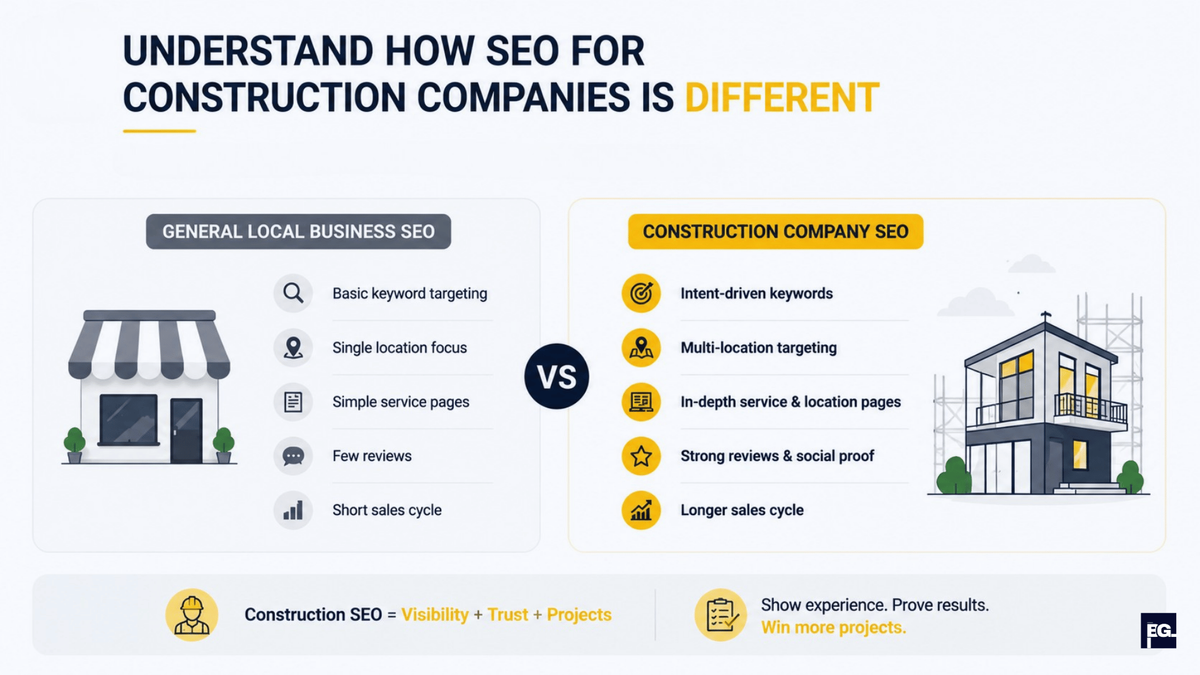
When I talk to construction owners, many assume SEO for construction company websites is the same as any other local business: add some keywords, get a few backlinks, and wait. In practice, successful guides from InvoiceFly, Dara Creative, and Local Mighty all point out that construction SEO has extra challenges: long sales cycles, high-ticket projects, and a huge need for trust before someone will even request a quote.
Marketing studies in the home improvement space show that 78% of consumers start their research online, 82% want to see before‑and‑after photos, and 54% prefer to book via online forms or websites. That means your SEO for construction companies isn’t just about being found, it’s about instantly proving you can handle complex, expensive work.
In simple terms: SEO for construction is about showing up where serious buyers look (Google, Maps, AI answers, review sites) and making it obvious, within a few seconds, that you’re experienced, local, and trustworthy enough to call.
Whenever I audit SEO for construction companies, I start with two things: the main website and the Google Business Profile (GBP). In many cases, the GBP has outdated hours, old photos, or the wrong service area, while the website loads slowly on mobile and buries the key services.
Semrush’s local SEO data shows that businesses appearing in the map pack (top 3 local results) receive significantly more clicks, calls, and direction requests than those ranked lower, and they tend to have more reviews and backlinks. In fact, the top 3 local results average 993 backlinks, 216 referring domains, and 561 Google reviews with a 4.8-star rating, according to Semrush. At the same time, broader SEO statistics show that pages ranking on page 1 often have around 1,400+ words of well‑structured content, not thin landing pages.
When we did just this “foundation” work for one contractor, no fancy tactics, just NAP cleanup, GBP optimization, and a faster homepage, they moved from barely visible to showing up more consistently in the local pack for their target city, and call volume from Maps started to climb.
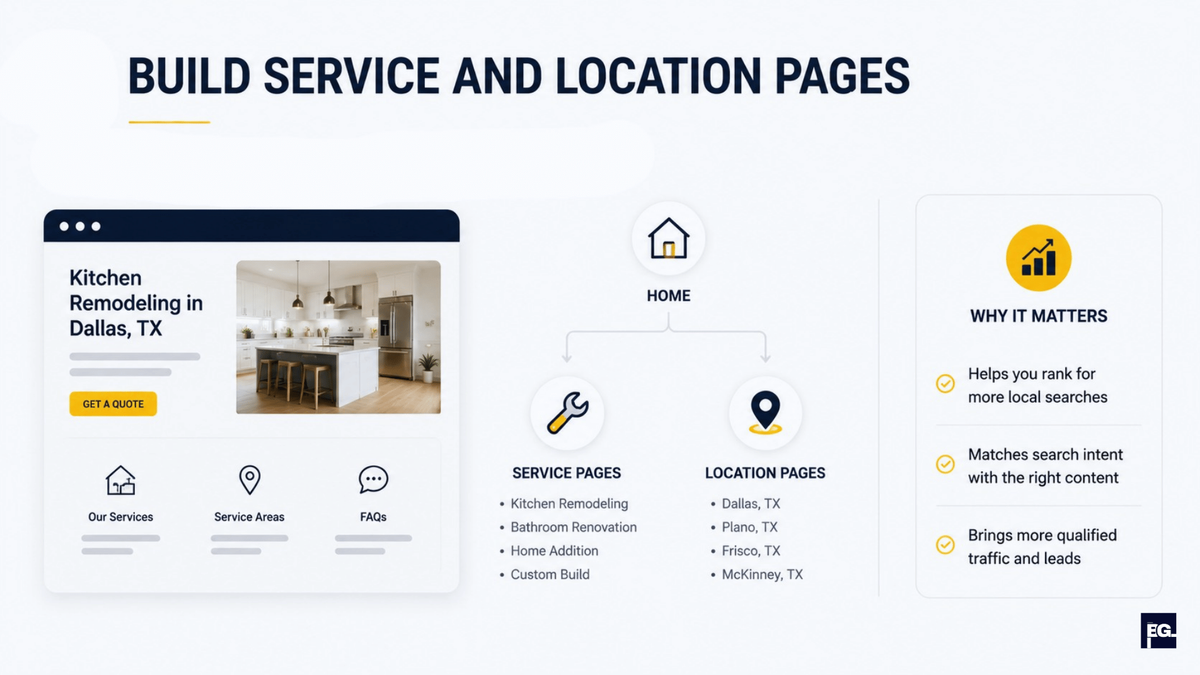
Once the foundation is in place, I focus the SEO for construction company content around two types of pages:
Guides from Local Mighty, MDM Marketing, and Contractor Growth Network all highlight the same pattern: the construction companies that win local SEO usually have structured, geo‑specific service pages instead of one generic “Services” page.
For each high‑value combination (e.g., “kitchen remodeling in Dallas”):
In practice, that’s how we make SEO for construction companies feel useful for the visitor, not just optimized for Google.
When I look at competitor blogs in this space, the best ones don’t just define “SEO” and “keywords.” They answer questions construction buyers actually ask: How long will this project take? How much disruption will there be? What affects the price? What happens if something goes wrong?
Industry data backs this up. Content marketing research shows that educational content can generate around 3x more leads than traditional outbound marketing while costing significantly less per lead, especially when it’s aligned with search intent, according to Content Marketing Institute. For contractors, that often means writing simple, straight‑talk guides instead of generic “Top 10 tips” posts.
Each of these can naturally use phrases like “seo for construction company” and “seo for construction” without stuffing because you’re literally showing how your construction company solves those problems in your city.
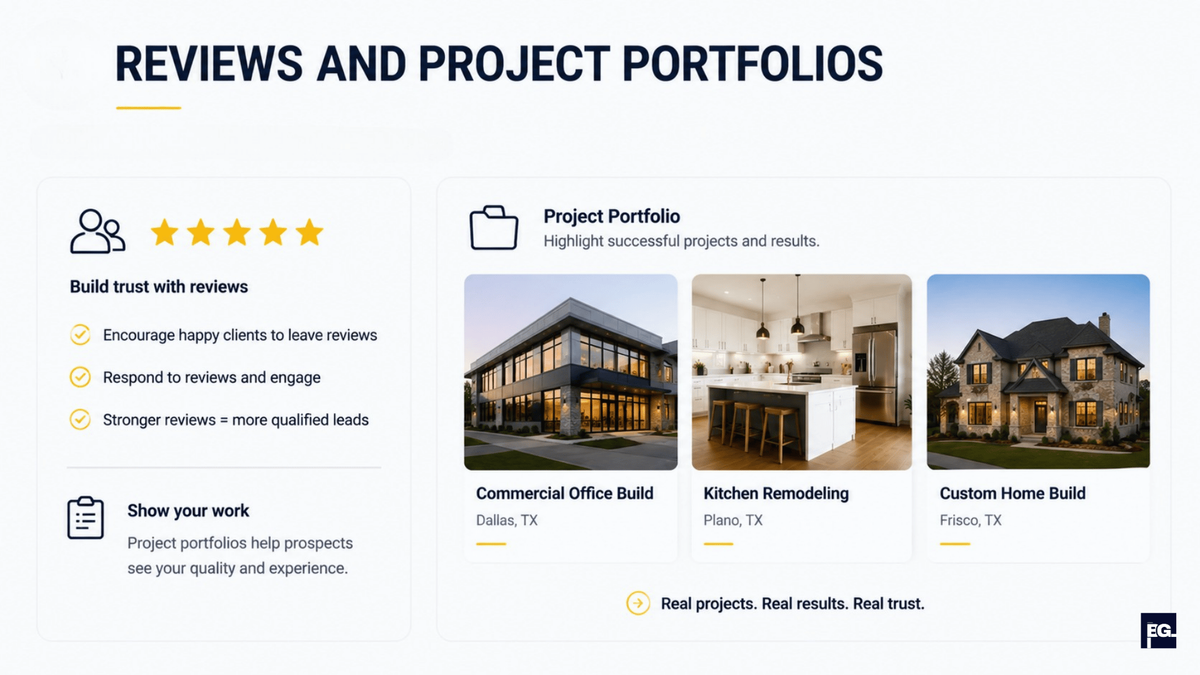
In most construction buying journeys, people don’t just search once and call. They search, compare, look at reviews, scroll through photos, and only then send an inquiry.
On top of that, home improvement research highlights that 82% of homeowners want to see before‑and‑after photos on contractor websites, and 72% say online photos and videos influence their decision. That means your review profile and portfolio are not “nice to have”, they’re core assets in your SEO for construction strategy.
When we did this for one construction client: building out 10+ case study pages and improving their review volume, they didn’t just get more organic traffic; their close rate on inquiries improved because prospects came in already trusting their work.
Local citations (consistent NAP mentions on directories and industry sites) help local SEO. For construction, the same rule applies, but with a twist: directories and industry platforms that homeowners actually use matter more than long lists of random directories.
Local SEO guides for contractors emphasize claiming profiles on Google Business Profile, Apple Maps, Bing Places, reputable industry directories, and local business sites, while keeping NAP fully consistent. At the same time, Semrush’s local stats show that businesses in the local map pack tend to have more backlinks and referring domains than those lower down.
This is the part of SEO for construction companies that feels slow, but over time those mentions and links tell both Google and AI systems that you’re a real, established player in your area.
In 2026, I don’t think we can talk about SEO for construction company websites without mentioning AI search. Newer guides are already advising contractors to think about how their content appears in AI‑generated answers and local recommendation tools, not just the classic ten blue links.
Local SEO studies also show that most businesses still don’t have a structured local SEO plan, even though those that do tend to outperform on traffic, calls, and conversions. For you, that’s actually an opportunity: a modest but consistent strategy can put you ahead of competitors who are still relying only on word of mouth.
How to get your construction business into AI answers
Generative engines like ChatGPT, Perplexity, and Google’s AI Overviews pull from websites that clearly demonstrate expertise, authority, and trustworthiness. For a general contractor or specialty trade contractor, here is what that means in practice:
When you start seeing that certain service/location pages or blog topics consistently generate better inquiries, you can double down on those and stop guessing what “should” work.
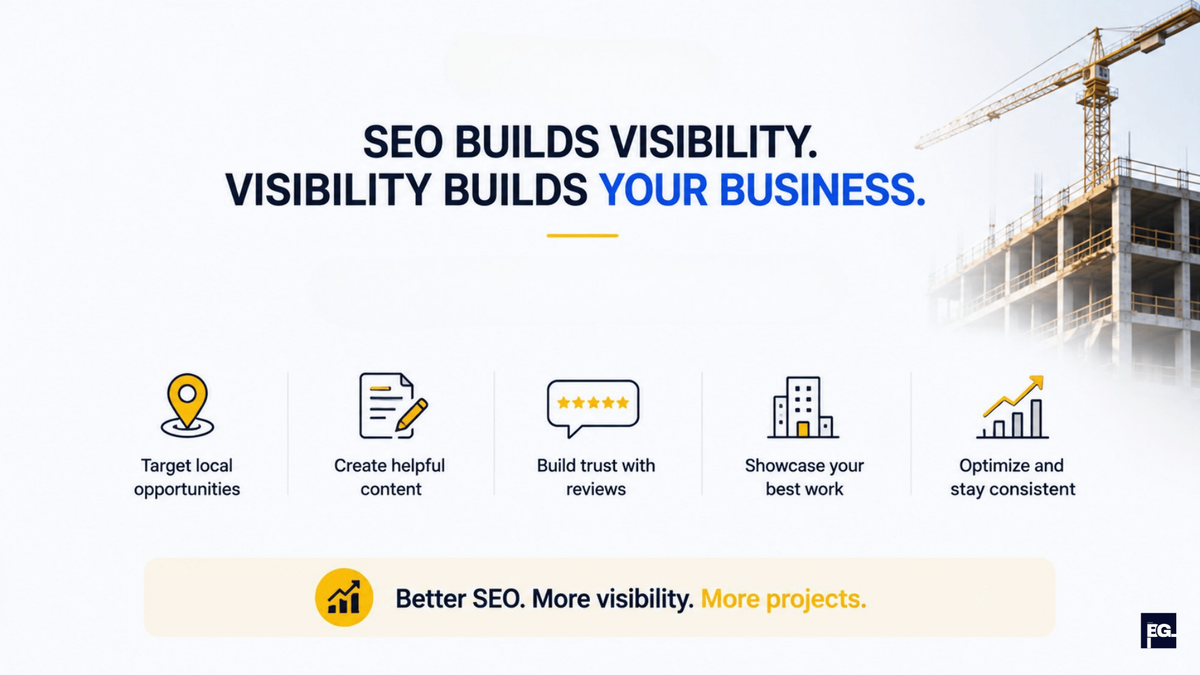
Across all the construction and local SEO research I’ve seen, one pattern is obvious: the companies that win aren’t always the biggest, they’re the ones that look trustworthy and easy to choose everywhere a homeowner or property manager might look.
If you treat SEO for construction as a trust engine, clean foundation, clear services, proof of work, strong reviews, and consistent local signals, you give Google, Maps, and AI tools plenty of reasons to recommend you. And you make it much easier for serious buyers to move from browsing to booking that first site visit.
If you need help with that, Our SEO experts can help your construction SEO with local optimization, GEO-friendly content, technical fixes, and lead-focused website improvements.
Q: Why does SEO matter so much for construction companies in 2026?
A: Because around 78% of home improvement consumers start their project research online, and 68% are more likely to choose a contractor with a strong online presence, so weak SEO means losing projects before you ever get a chance to quote.
Q: What’s different about SEO for construction versus generic local SEO?
A: Construction SEO has to handle high‑ticket projects, longer sales cycles, and a big trust gap, so portfolios, reviews, case studies, and detailed service/location pages matter much more than in low‑risk local niches.
Q: Which pages should a construction company prioritize first?
A: Start with a solid homepage, then build out clear service pages and geo‑specific location pages that match how people actually search (for example, “home renovation contractor in [city]”).
Q: How do reviews and photos impact SEO for construction companies?
A: Local SEO and home improvement studies show that 75–97% of people read reviews, 78% won’t consider a business under 4 stars, and over 80% want to see before‑and‑after photos before they contact a contractor.
Q: What role do citations and links play in construction SEO?
A: Consistent NAP citations on maps and directories, plus quality backlinks from local and industry sites, help you appear in the local map pack, which can drive 126% more traffic and 93% more actions than lower local positions.
SEO for construction companies is the process of improving your website, Google Business Profile, and overall online presence so you rank higher when people search for construction services in your area, and so those visitors feel confident enough to request a quote.
Most construction SEO campaigns start showing noticeable movement in 3–6 months, with stronger results around the 9–12 month mark, especially if you’re building service/location pages, reviews, and content consistently over that period.
Yes. Since most construction work is tied to specific cities or regions, local SEO (Maps, local packs, geo‑focused pages, citations) usually delivers better ROI than chasing broad national keywords that attract visitors outside your service area.
There’s no magic number, but SEO studies show that pages ranking on page 1 often have substantial, high‑quality content, and construction guides that publish regular, helpful articles tend to rank for more long‑tail queries and generate more leads over time. Even 1–2 focused posts per month can compound if they’re well targeted.
You can absolutely start on your own by fixing your GBP, building clear service/location pages, and consistently collecting reviews but as you grow, many contractors partner with specialized agencies so they can focus on projects while experts manage the technical and content workload.
Not necessarily. If you actively work in a city and can legitimately describe your work there, a dedicated location page with real content (projects, team presence, local references) is worth creating. But thin pages created just to target a keyword, with no real local content, tend to hurt rather than help. For most small contractors, 2–4 strong location pages beat 20 weak ones.
Not if your content is built the right way. AI tools actually pull from websites they trust, which means if your site has strong authority, clear structured content, and genuine expertise signals, you are more likely to be cited in AI-generated answers, not less. The companies losing traffic are the ones with thin, generic content that AI can summarize in one sentence.